
Generally Accepted Appearance Principles.
You know GAAP from accounting, the principles everybody agrees to work from. Turns out getting dressed has one too. Nobody wrote it down, you just picked it up over the years without noticing. There are ideas about how clothes read on you that hold up pretty much everywhere, and LookSense knows them cold. Not to tell you what to do. To show you the why, and let you kill any rule that isn't yours.
We don't just say X goes with Y. We tell you why.
Here's the thing: your clothes talk before you open your mouth. What you throw on says something about you whether you meant it to or not. The "rules" are just what people worked out about that over a few thousand years. Some of it holds up everywhere. Most of it is local. A lot of it is just you. LookSense tracks way more of it than you ever could, and treats all of it as a suggestion you can keep or toss.
Black's for funerals here. White's for funerals across most of Asia. Red is luck and weddings in China and India, and basically a stop sign everywhere else. There's no universal right color. It depends on where you are and who's in the room.
People clock the material before they clock the color or the cut. Shiny, matte, heavy, thin, that hits first. The same shirt in real wool versus cheap poly says two totally different things in the same room. Know what it's made of and you're already halfway to knowing where it belongs.
Lots of traditions have rules about what a piece has to cover, from tzniut in Judaism to modest dress in Islam and plenty more. Those are yours to set. We never override them. Your lines come first, full stop.
A kimono wraps left over right on a living person. Right over left is only for the dead. One tiny move, huge difference. The best details are the ones nobody notices until somebody blows one.
No white after Labor Day. Belt matches the shoes. Good to know, kind of made up, and totally fine to break on purpose once you know it. The point was never to obey the rule. It's knowing when it actually matters and when it doesn't.
There's a rule in the Bible our scanner could enforce.
It's called shatnez. Old Jewish rule: you can't wear wool and linen woven into the same piece. People who keep it send their clothes to special labs, where somebody literally picks the threads apart under a microscope, because the mix is usually hiding in a lining or a collar the tag never told you about.
LookSense reads what a fabric is made of from one scan. So in theory, the same scan that says "navy wool blazer" could catch a wool and linen mix the label missed. That's the whole thing in one ancient rule: what your clothes are made of actually means something, and we can measure it.
Real, or total BS?
Some of these are principles people actually live by. Some are stuff somebody made up and everybody just kept repeating. Can you tell them apart? Pick a category or take them all.
That was everyone's rulebook. Here's yours.
In the app, every rule is a switch. Turn off the ones that aren't you, and LookSense builds outfits from your actual closet around the ones you keep. Go ahead, flip a few:
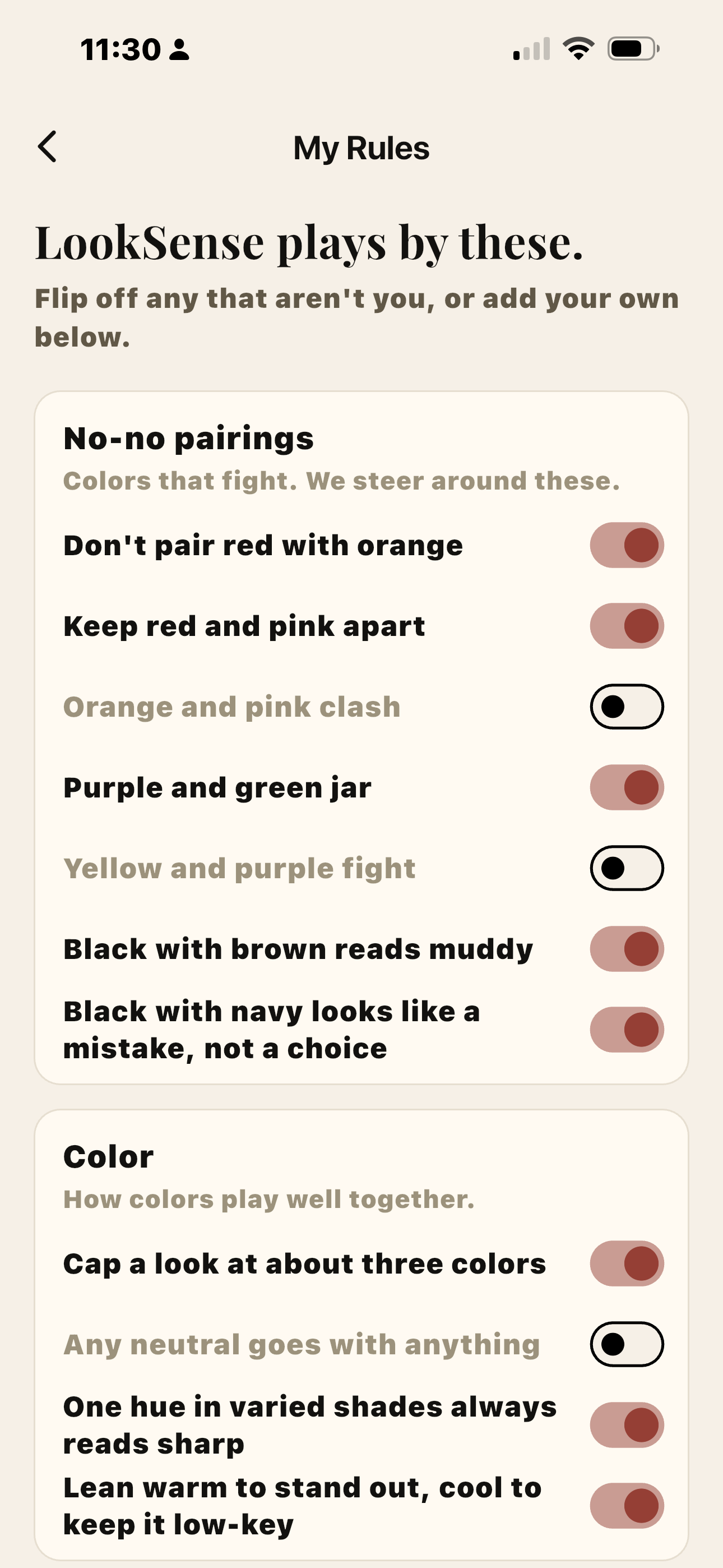
Generally accepted, not specifically.
That word matters. These are starting points, not commandments. A rule you can't turn off is just a boss with extra steps. LookSense tells you why it's nudging you one way, respects whatever lines you draw, and shuts off any rule the second it stops being yours. Generally accepted gets you in the ballpark. Specifically right is you, and that part's yours to set. Same tool for everybody, whoever you are, however you're built, whatever you believe.
Try it on your own closet.
Scan what you've got and watch all this land on your actual clothes. Keep what you like, kill the rest, and find out what your closet has been saying about you this whole time.
Get early access