Not a camera. Not a guess. Real light.
Color and material have a spectral signature: a curve of reflectance across wavelengths that a three-channel camera collapses and throws away. LookSense keeps it. A spectral sensor reads fourteen bands from 415 to 940 nanometers, out past visible light into the near-infrared, under its own full-spectrum LED, so the read describes the cloth itself and not the room it is in. Every read is a vector. Every read a human confirms becomes training data. The estimate becomes a measurement, and the measurements compound.
And the range is not fixed. The same pipeline extends into the short-wave infrared, out to 2300 nanometers, for water, moisture, and material reads well beyond the closet.
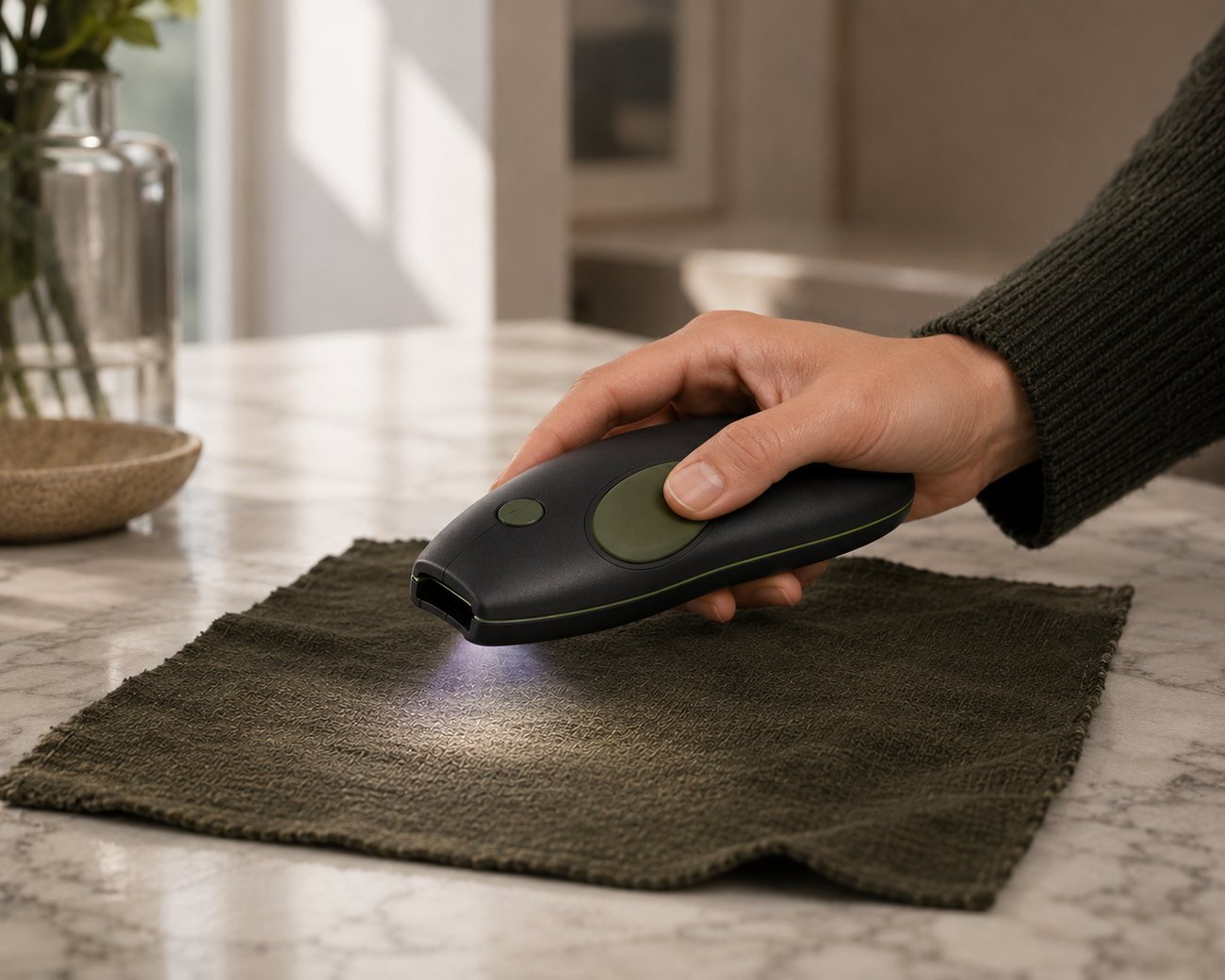
This page is how LookSense reads a garment. For how it decides what you should actually wear, see How your outfit gets decided →
It doesn’t just see. It remembers.
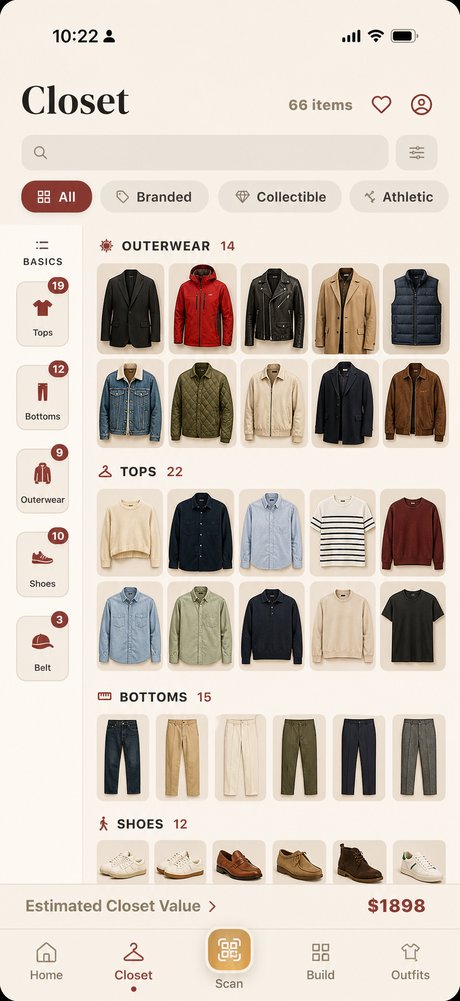
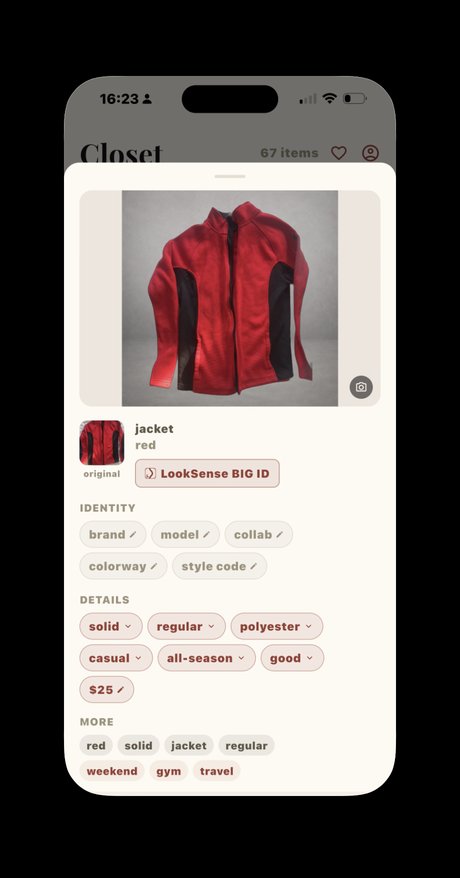
The camera app is live now, not a concept. Point it at a piece and it recognizes the garment, names color and fabric, builds a look from the rest of your closet, and can speak the answer out loud. This runs on the phone in your hand.
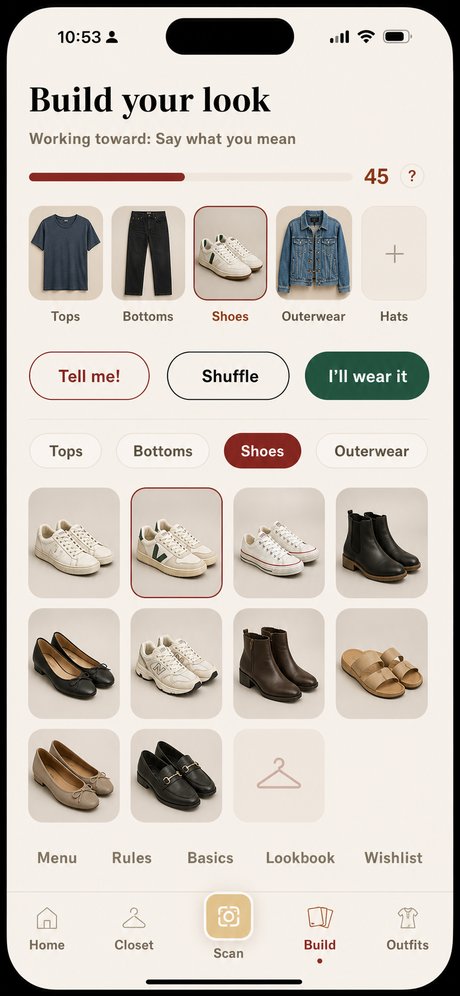
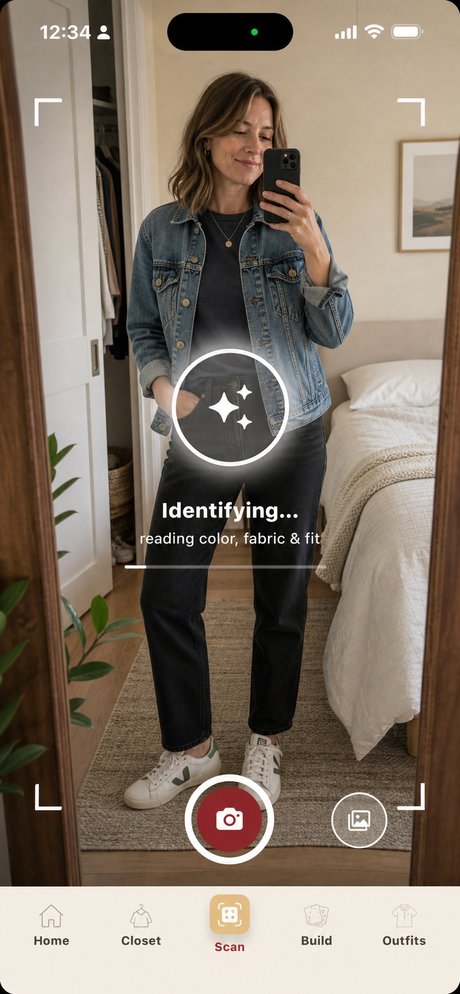
A camera sees three numbers. We read fourteen.
RGB is a lossy summary of light, built for human eyes and screens. It cannot separate navy from black, or cotton from a synthetic that happens to match, because both collapse to the same three values. A spectral read does not collapse. It measures where the light actually goes, band by band, and keeps the whole curve.
Sight is where LookSense starts. It is not where it stops.
The read is a fingerprint.
One contact scan produces a spectral vector, then a fabric class, then a color. Each step is measured or matched, never inferred from a photo.
The sensor returns a channel map for clothing across 415 to >1100nm (f1..f8, clear, and near-infrared). LookSense works with other 1100, 1450 and 1940nm bands, up to 2300nm for H20 based needs. Its own full-spectrum LED lights the cloth, so the read holds up in any light, or none. Ambient conditions stop mattering because the sensor supplies the light it measures.
The normalized spectral vector is scored by cosine similarity against a library of fabric centroids, returning a class and a confidence. Cotton, wool, and a synthetic blend that read the same to a camera separate cleanly here, because they reflect differently in the near-infrared.
The read resolves to CIE Lab and a plain color name, then adjusts to the person’s color vision. Deuteranopia, protanopia, tritanopia, and low vision each get a description tuned to how they actually see, from the same underlying measurement.
One data model. Three ways in.
Accuracy scales with hardware. The record does not change. Every capture is the same scan, tagged by source, so the wedge and the lab tier feed one corpus.
Phone camera
Computer vision on an ordinary photo. Lowest accuracy, near-zero cost, and how most people start. No spectral claim here: it is an estimate that still feeds the corpus.
Standalone wand
A low-cost multi-channel spectral sensor and a small dedicated inference chip, preloaded with fabric signatures and voices. Real spectral color and fabric reads on-device, offline. Pairs over Bluetooth and relays scans to the cloud.
Edge vision + spectral
A single-board compute module, a dedicated vision co-processor running a compiled object-detection model in real time, and a lab-grade multi-channel spectral sensor. Full capture and segmentation. The reference tier.
All three write the same scan row with a different source tag. That is the whole trick: the phone gets us into millions of hands, and every tier deposits into the same growing record.
The training set is a query, not a file.
Every scan is stored raw: the exact channel map, the acquisition metadata, and the derived color and fabric with a confidence. It sits inert until a human confirms what it actually was. That confirmation is the ground truth.
Every read also records which model version classified it, so “the device got smarter” is a measurable fact, not a slogan. Confirmed scans distill into a frozen centroid pack that ships to the wand’s firmware. Usage sharpens the cloud; the cloud sharpens the hardware. That loop is the asset, and it only exists because we kept the raw spectrum instead of a color name.
Edge to cloud, built to not lose a read.
The capture happens at the edge; the truth lives in the cloud. In between is a write-ahead log so a network blip never costs a scan.
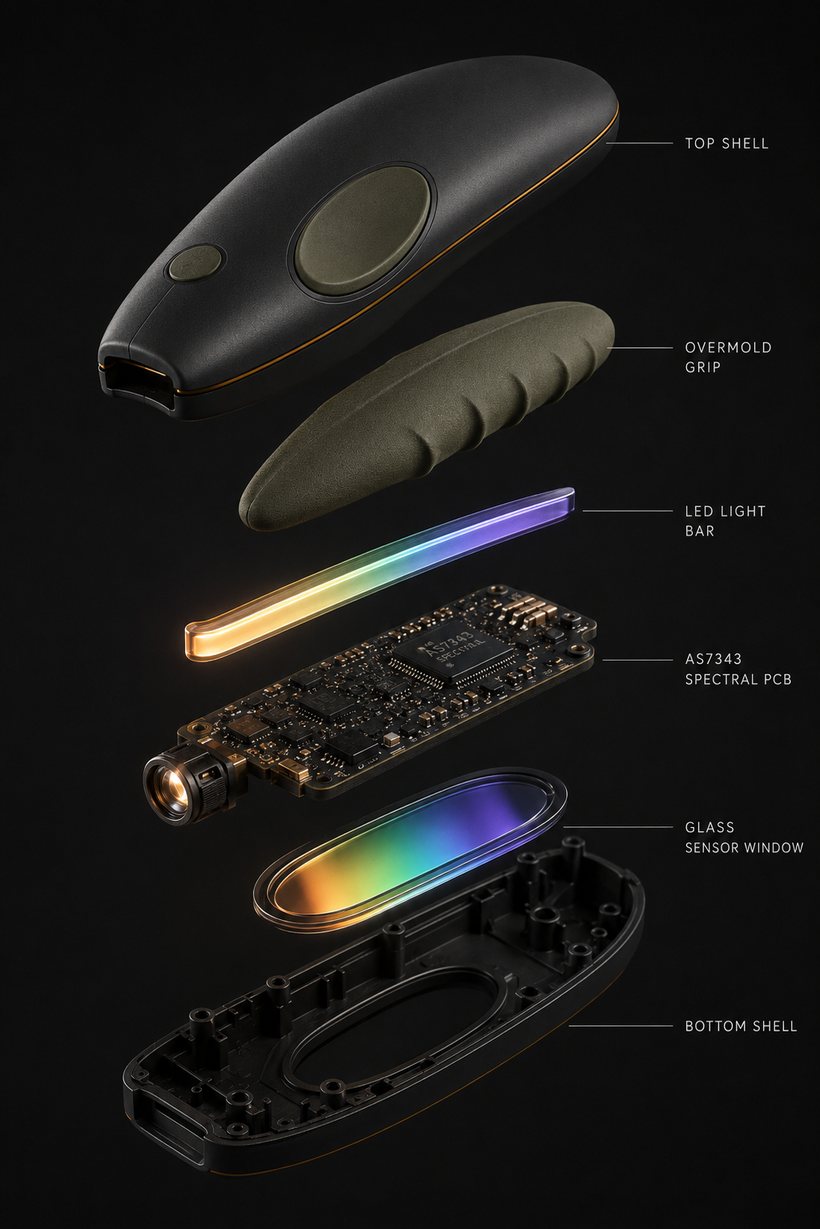
Every layer earns its place.
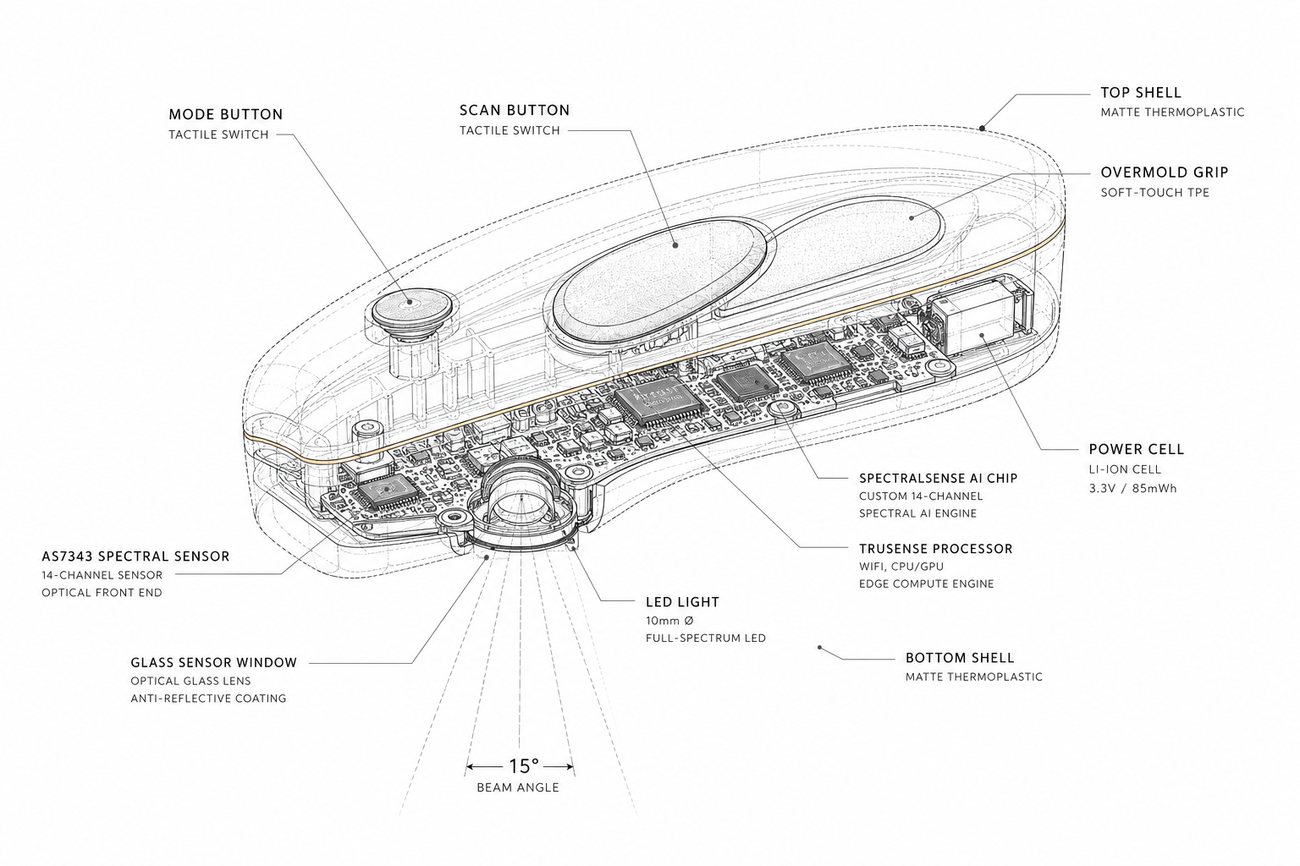
The reader, cut away. Lab-grade colorimetry in a device that fits a pocket.
What we considered. What we cut. What we kept.
A few of the ideas we prototyped, argued over, and decided on. Honestly.
Camera-only color ID
Fine as a wedge, wrong as a foundation. A camera guesses from ambient light; the spectral read measures. Navy and black are the same in a photo, never to the sensor.
Puck / stone shape
Beautiful on a nightstand, terrible for fabric contact. The wand shape presses the sensor window flat to a garment, which is what an accurate read requires.
Raw over derived
We store the full spectral channel map, not just the color name it produced. It costs more to keep, and it is the only reason the corpus can get smarter later.
Built to still be right in ten years.
Trends shift and chat models get replaced. Measured light does not. What the sensor reads today it will read the same a decade from now, and every garment someone confirms makes the descriptions sharper and the models deeper. This is made to age into something better, not to look good in a demo and fade.
See what the sensor actually sees.
Your phone reads three broad channels — red, green, blue — through whatever light you happen to be standing in. The spectral sensor takes fourteen readings and brings its own calibrated light, so the answer doesn’t move when the room does. That’s how it calls navy from black when your eyes can’t — and how “true color” stops being a marketing word.
We put the whole thing on its own page, including a straight account of what it can’t do yet. Most hardware pages won’t tell you that. We’d rather.
What it can and can’t do →The app works today. The reader is what’s next.
The phone wedge ships now. The prism and the full spectral rig are the accuracy tiers behind it. Want first crack at the hardware?
Reserve a prism →Sight is where we start. It is not where we stop.
Follow the platform →