A camera sees a picture. This reads the light.
Your phone guesses colour from three broad channels — red, green, blue — filtered through whatever light you happen to be standing in. A spectral sensor doesn't guess. It takes fourteen narrow readings under a light it controls, so the answer is the same in a shop, a hallway, or the sun. That's how it tells you navy from black when your eyes can't.
Why fourteen channels beats three
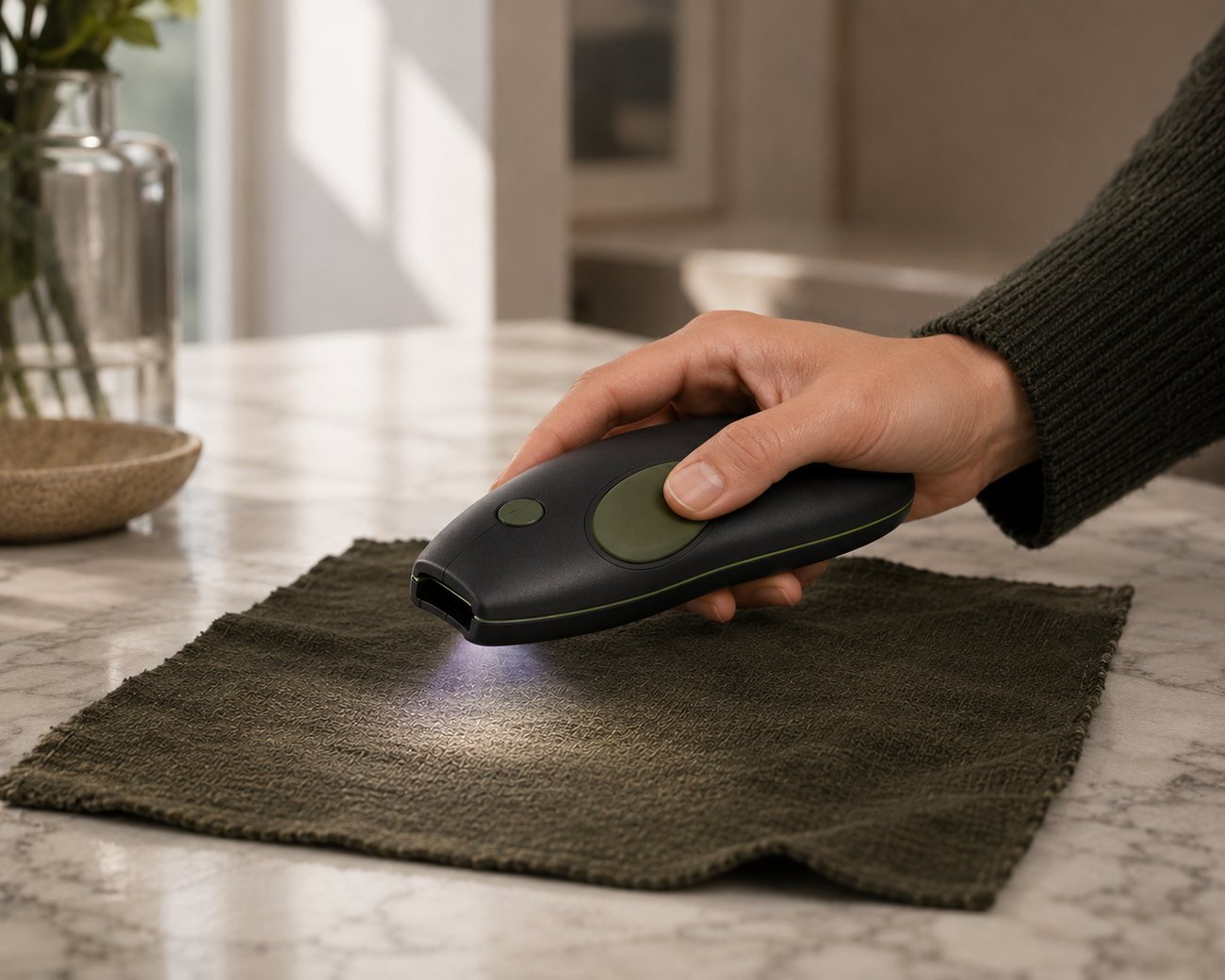
A phone camera has three broad colour channels and no light of its own. So what it really reports is "what this looked like, in that light, to that lens" — which is why the same shirt photographs olive in the kitchen and grey in the hallway, and why you can't trust it.
The spectral sensor takes fourteen narrow readings and brings its own calibrated light. It isn't guessing under your lamp; it's measuring a surface under a light it controls. That's what makes the answer repeatable — same garment, same reading, every time, anywhere.
And fourteen readings instead of three means it separates the colours that collapse into each other for a lot of people: navy from black. Charcoal from brown. Sage from grey. That isn't trivia. Those are the exact calls that go wrong every single morning for someone who is colourblind or low-vision — and it just says the answer out loud.
A real read, off our rig.
This is actual data — the raw spectral channels the sensor recorded, exactly as they were stored. Nothing smoothed, nothing illustrated. It is shown three ways on purpose: in plain words, as numbers, and as a chart — so it reads the same whether or not you can see the picture.
Show the exact numbers
Three ways in. One brain.
The sensing gets better as the hardware gets better — but every tier writes into the same place, and we are honest about what each one can actually claim.
Your phone
The camera you already own. Good enough to name a colour, catalogue a closet, and build a look. Not lab-grade — and we never pretend otherwise.
The prism
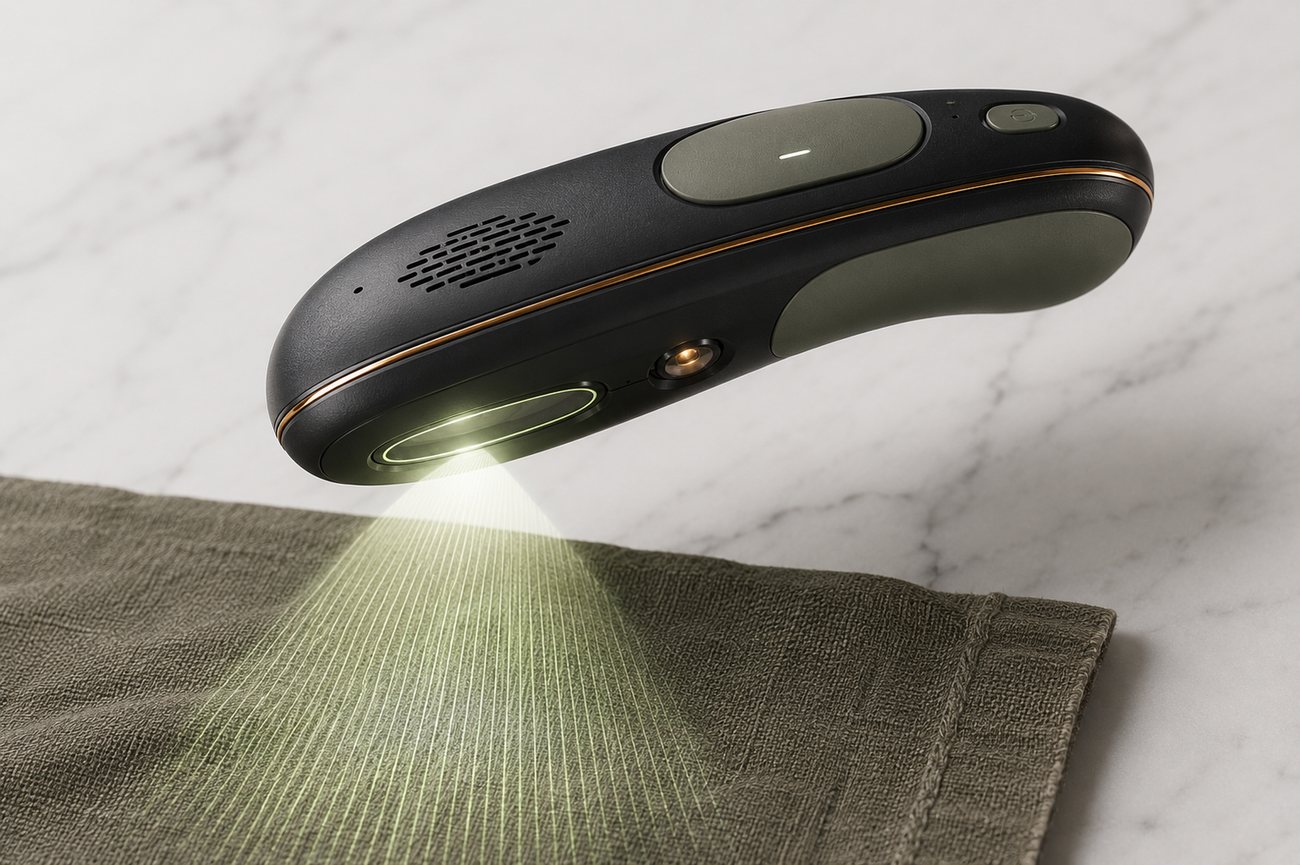
A small standalone wand with a real spectral sensor inside. Touch it to the fabric, hear the answer out loud. Works offline, no phone required, and passes its readings along when you're back in range.
The full rig
Spectral sensor plus a vision camera running its model on-device. The bench where the science gets proven.
What it can't do yet. We'd rather just tell you.
It cannot reliably tell you what a garment is made of. Not today. Here's the honest reason, and it isn't a bug we're about to fix.
The wavelengths that actually identify a fibre — the ones separating wool from cotton from polyester — sit far out in the infrared, well past what this sensor can physically see. That's the chip, not the software. And it isn't just us: nobody has demonstrated reliable fibre identification below the range we're working in — not research labs with ten times our channel count, not the commercial sorters. The instruments that do it properly cost more than a car and don't fit in a pocket.
So when we tell you a colour, we mean it. When we guess a fabric, we'll say "probably" — and we'd rather say that than sell you a number we can't stand behind.
Two things could change it, and we're chasing both. A different sensor that reaches those wavelengths. And — more interesting — the camera. Weave, sheen, and drape are how an experienced eye tells wool from polyester across a room, and our camera already sees all three. Teaching the light and the lens to work together may get there before new silicon does.
It gets smarter because you use it.
Here's the part that compounds. Every scan is stored with its spectral signature. When a person confirms what the thing actually was — "that one's navy, not black" — the scan stops being a guess and becomes ground truth.
Enough ground truth and we can distil it into a better model, then ship that model back into the device. The sensor you own gets better over time without you doing a thing. Every reading records which version of the brain interpreted it, so "it's getting smarter" isn't a slogan — it's a number we can show you.
This is why we're fussy about the boring part: provenance. Every reading is tagged with what actually took it — phone, prism, or rig. A phone-camera guess never gets dressed up as a spectral measurement, and a fabric hunch never gets dressed up as a fact. If we won't stand behind a number, we don't print it.
Get in line for one.
The prism is still in development. There is no ship date and we are not taking a penny. This puts you on the list: first to know when it's real, first offered one.
No payment, no obligation, no spam. Just a note when there's something worth telling you.
You're on the list. We'll come find you when it's ready.
Honest status: the app and phone-camera scanning are live today. The prism is a working prototype on our bench, not a product you can buy. We'd rather tell you that than sell you a date we can't keep.